The 3M Series
The 3M Series
Part 1 of 7: Who is 3M
Most people know 3M for Scotch tape and Post-it notes. Here in Darlington County we need to know them for something else.
3M started on June 13, 1902 in Two Harbors, Minnesota as Minnesota Mining and Manufacturing. Five local men founded it: Henry Bryan, Hermon Cable, J. Danley Budd, John Dwan and William McGonagle. They meant to mine corundum for grinding wheels. The rock turned out to be worthless. Investors Edgar Ober and Lucius Ordway took over in 1905 and moved the company to Duluth. It turned to sandpaper, then masking tape in 1925 and Scotch tape in 1930. Today it sells thousands of products worldwide.
After World War II, 3M got into fluorochemicals. These are the chemicals we now call PFAS, or forever chemicals. 3M was one of the first companies to make them and one of the biggest.
In the 1950s 3M brought out Scotchgard. It made carpet, furniture and clothing resist stains and water. Textile mills all over the South used stain and water repellent finishes like it on fabric.
Scotchgard's key ingredient was PFOS. That is the same chemical showing up in our soil and wells today.
3M also made PFOA, another forever chemical, starting in 1947. From 1951 on, DuPont bought it from 3M to make Teflon. DuPont called it C8. 3M was the original maker and DuPont was its biggest customer. When 3M stopped making it, DuPont built its own plant in 2002 at Fayetteville, North Carolina, the plant behind the Cape Fear River contamination.
Remember both names. 3M made these chemicals and DuPont was its biggest customer for half a century.
PFAS do not break down. What went into the ground decades ago is still there.
Next: Joseph Simons, the man behind the process.
Sources
Part 2 of 7: Joseph Simons, the man behind the process
Every forever chemical 3M made traces back to one man's invention. His name was Joseph Simons.
Simons was born in Chicago on May 10, 1897. He studied chemistry at the University of Illinois and graduated in 1919. He earned a master's degree in 1922 and a doctorate in 1923 at the University of California.
He became a professor of chemical engineering at Penn State. In the late 1930s he ran fluorine gas through a carbon arc and made fluorocarbons.
In 1940 Harold Urey recruited him to the Manhattan Project to help build the atomic bomb. His fluorocarbons could stand up to uranium hexafluoride, so they were used for seals, gaskets and pipes. The work was classified until after the war.
Before Simons, making these chemicals meant handling pure fluorine gas. It was dangerous and wasteful. He found a safer, cheaper way: run an electric current through a hydrogen fluoride solution. It became known as the Simons process.
3M licensed his process in 1945 and partnered with him and Penn State in 1946. 3M's own company history says Simons believed early on that these chemicals would make superior repellents for water, oil and stains. That idea became Scotchgard.
His patent was issued in 1950 and assigned to 3M. That same year he moved to the University of Florida in Gainesville, where he worked at its Fluorine Research Center. He discovered over 800 fluorine-based materials. He retired in 1967 and died in Gainesville on December 30, 1983, at 86.
3M made PFOA and PFOS with his process. It ran the process at plants in Cottage Grove, Minnesota, Cordova, Illinois and Decatur, Alabama.
Next: what 3M knew, and when they knew it.
Sources
Part 3 of 7: What they knew and when
In 2010 the State of Minnesota sued 3M for polluting its groundwater with PFAS. 3M settled in 2018 for $850 million. Afterward the Attorney General released thousands of 3M's own internal documents.
Here is what those documents show, according to reporting on them:
- 1950s 3M animal studies found its PFAS chemicals were toxic.
- 1960s By the early 1960s, 3M knew the chemicals did not break down in the environment.
- 1968 University of Rochester researchers found an organic fluorine in human blood. It was later traced to the Scotchgard chemical PFOS.
- 1970s 3M knew its chemicals were in the blood of the general public.
- 1976 3M tested its own workers. Some at its Cottage Grove plant had up to 1,000 times the normal level in their blood.
- 1979 3M lawyers advised the company to keep a compound found in human blood under wraps.
The company kept selling. 3M says the documents give an incomplete and misleading picture.
That was 14 years before the first load of Galey & Lord sludge went on a Darlington County field.
Next: how 3M finally stopped, and how EPA thanked them for it.
Sources
Part 4 of 7: The phaseout
In May 2000, after negotiations with EPA, 3M announced it would phase out PFOS, the key ingredient in Scotchgard.
The reason, in EPA's own words at the time: 3M's data showed these chemicals last a very long time in the environment and build up in human and animal tissue.
EPA's administrator gave 3M great credit for coming forward voluntarily.
But the same year, 3M handed EPA hundreds of documents it had been holding back. In 2006, EPA fined 3M $1.5 million for reporting violations, including late reporting of substantial risk information.
3M also told carpet makers they could keep selling products already treated with Scotchgard under the existing labels. Global production of these chemistries did not end until 2002.
Think about the timing. Galey & Lord sludge started going on Darlington County fields in 1993. The phaseout came seven years later. Nobody was testing sludge for PFAS then, and nobody is required to test it now.
3M says it stopped making all PFAS at the end of 2025. What went on our fields is still there.
Next: the Darlington County connection.
Sources
- EPA press release, May 16, 2000: EPA and 3M announce phase out of PFOS
- CleanTechnica: 3M handed EPA withheld documents in 2000
- EPA press release, April 25, 2006: $1.5 million settlement with 3M
- Textile World, July 2000: 3M phasing out chemical in Scotchgard
- 3M: PFAS exit status
- The State via PFAS Project: Galey & Lord sludge in Darlington County
Part 5 of 7: How it got here
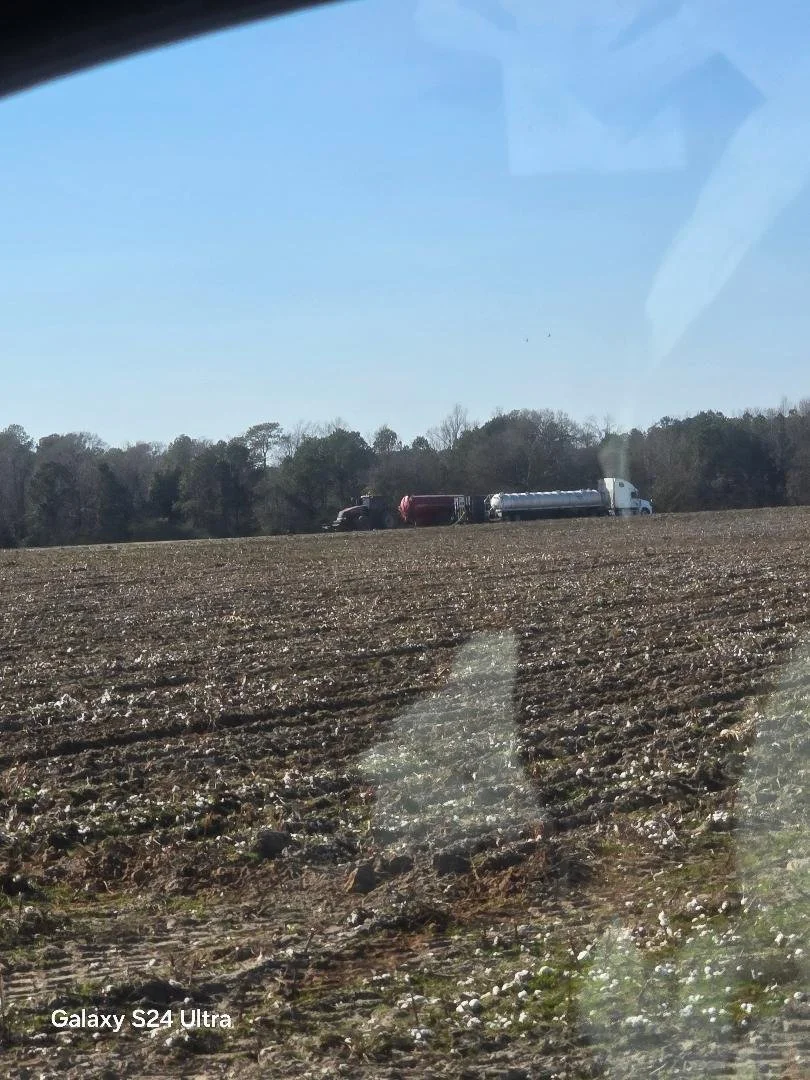
The Galey & Lord textile mill in Society Hill gave its waste sludge to farmers as free fertilizer starting in 1993, for about 20 years. EPA says it went on more than 300 fields covering nearly 10,000 acres. The mill closed in 2016 and is now a federal Superfund site.
How did PFAS get into that sludge? Textile mills used stain and water repellent finishes on fabric. Those chemicals washed out with the wastewater and ended up in the sludge.
Here is what the sludge left behind:
Soil on one Society Hill farm tested as high as 55 ppb PFOS. Maine's screening level for PFOS in hay-field soil on an average dairy farm is 13.8 ppb.
Black Creek Elementary sits on a field that got Galey & Lord sludge.
Wells near sprayed fields have needed EPA filters.
The mill is gone. The companies that made the chemicals are still here.
Next: the full timeline.
Sources
- The State via PFAS Project: Galey & Lord sludge on nearly 10,000 acres
- Maine PFAS screening levels, June 2021 (soil to hay to milk)
- Farm soil results, Black Creek Elementary and well filter details: local testing records and SC Department of Environmental Services documents
Part 6 of 7: The timeline
How forever chemicals got from a lab to Darlington County:
- 1938 DuPont chemist Roy Plunkett discovers PTFE, later sold as Teflon. It is usually counted as the first PFAS.
- 1940 Joseph Simons joins the Manhattan Project.
- 1945 3M licenses Simons' process.
- 1946 3M partners with Simons and Penn State.
- 1947 3M begins making PFOA.
- 1949 3M builds its first pilot plant using the Simons process.
- 1950 Simons' patent is issued, assigned to 3M.
- 1951 DuPont starts buying PFOA from 3M to make Teflon.
- 1956 Scotchgard goes on sale.
- 1961 DuPont knows PFOA enlarges livers in mice.
- 1976 3M finds its chemicals in its own workers' blood.
- 1979 3M lawyers advise keeping a compound found in human blood quiet.
- 1993 DuPont knows PFOA causes tumors in lab animals and keeps using it.
- 1993 Galey & Lord sludge starts going on Darlington County fields.
- 2000 3M announces it will phase out PFOS under EPA pressure.
- 2002 DuPont builds its own PFOA plant in Fayetteville, NC.
- 2016 Galey & Lord closes. The mill becomes a Superfund site.
- 2018 3M pays Minnesota $850 million.
- 2024 3M's water system settlement of up to $12.5 billion is approved in Charleston.
- 2025 3M says it has stopped making all PFAS.
- 2026 The New Jersey settlement against 3M, DuPont and others is approved.
Eighty-eight years from the first one to today. The chemicals are still in our soil.
Next: who gets paid, and who doesn't.
Sources
- EWG: Plunkett and Teflon
- Penn State MRI: Joseph Simons
- 3M: history with fluorochemicals
- 3M, 1999: The Science of Organic Fluorochemistry
- Wikipedia: PFOA
- Wikipedia: 3M
- Minnesota Reformer: what 3M knew
- EPA press release, May 16, 2000
- The State via PFAS Project: Galey & Lord
- The Intercept: Minnesota settlement
- Fortune: 3M water system settlement
- 3M: PFAS exit status
- Philadelphia Inquirer: Court approves New Jersey's $2.5 billion PFAS settlements, August 2026
Part 7 of 7: Who gets paid
3M has agreed to pay billions over PFAS. Here is where the money is going:
Public water systems: $10.3 billion, up to $12.5 billion, paid over 13 years. Approved in federal court in Charleston in 2024.
Minnesota: $850 million in 2018.
New Jersey: 3M's share of a $2.5 billion settlement, $400 to $450 million, approved August 7, 2026.
Notice who is missing. Farmers whose fields got sludge. Families on private wells. A school built on a sludge field.
The water system deal covers city and county water. It does not cover land, crops, cattle or the well behind your house. People in that situation are left to sue on their own.
And the rules have not caught up. There is still no federal limit on PFAS in sludge and no requirement to test it before it goes on farmland. Sludge is still being spread in Darlington County today, now mostly from poultry processing.
What we are asking for:
SC Department of Environmental Services should require PFAS testing of all sludge before it is spread.
Test the fields and wells that already got it.
The companies that made these chemicals should pay to clean up our land, not just city water.
If your land got sludge or your well is near a field that did, get it tested. Contact us if you need help knowing where to start.
Sources
- Fortune: 3M to pay more than $10 billion to water systems
- The Intercept: Minnesota's $850 million settlement
- Philadelphia Inquirer: 3M to pay $400 to $450 million to New Jersey over 25 years
- NJBIZ: New Jersey secures court approval for $2.5 billion DuPont, 3M PFAS settlements
- Spotlight on America: no federal limits or testing for PFAS in sludge